1 Why Bother with Competitive Analysis
1. Better decisions. Understanding competitors’ products helps you position your own — and steer clear of the strongest players so you don’t wander into a red ocean. It lowers the risk of getting your bets wrong.
2. Learning from others. Studying what makes a competitor’s product strong lets you build more deliberately: take what works, absorb their strengths, and use it to sharpen your own edge.
3. Early warning. Keeping an eye on how competitors evolve means you catch disruptive substitutes or new policy changes early, so you can react before they hurt you.
2 Product Lifecycle and Competitive Analysis
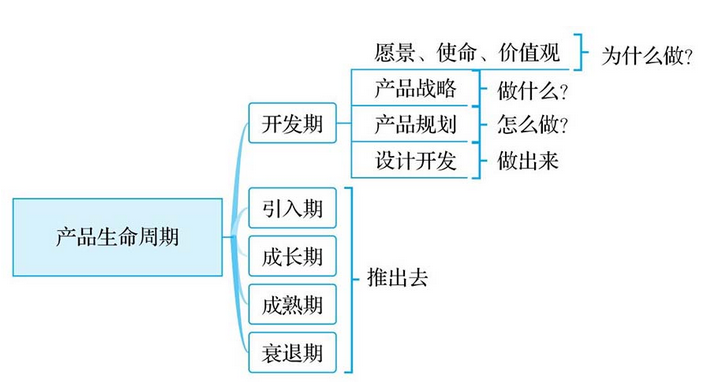
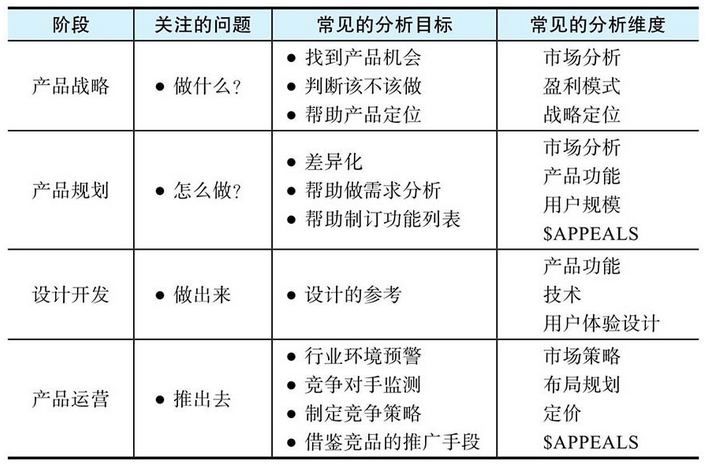
3 The General Process
- Get clear on the goal — why are you doing this analysis
- Pick your competitors
- Decide what dimensions to analyze
- Gather information
- Organize and analyze it
- Write up the summary report
3.1 Getting Clear on the Goal
- Why is this product doing a competitive analysis in the first place?
- What stage of its lifecycle is it in?
- What are the current problems and challenges — can competitive analysis actually help solve them?
- What’s the underlying purpose of doing this?
- What are the concrete objectives (the purpose is reached by hitting a set of specific objectives)? These objectives might include: supporting a decision, early market warning, or learning from competitors. For example: figuring out whether this product has a future and is worth building, and how to make money from it; seeing how a successful competitor did it so you can do something similar and grab market share; or tracking the market regularly to catch risks early and understand why your share is shrinking so you can course-correct.
- What’s the deliverable — a standalone report, or part of a business plan / project proposal?
3.2 Picking Competitors
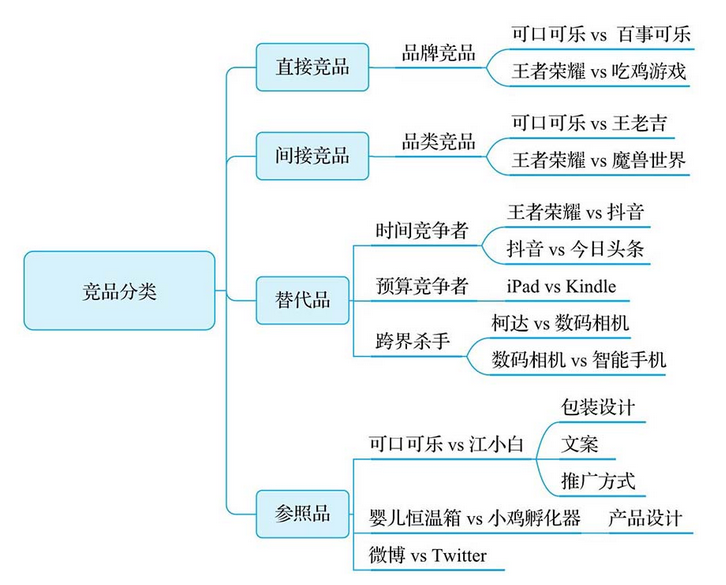
The selection criteria depend on your goal:
- For decision support or risk warning, look at brand competitors, category competitors, and substitutes — screened by market share, whether they’re backed by a big company, user feedback, and cross-industry substitutes.
- For learning from others, look at brand competitors, category competitors, and reference products — screened by market share, cross-industry references, and category pioneers.
Once you’ve shortlisted candidates, narrow them down again based on your actual situation — your goal, your own market share, how competitive the market is, what stage your product is at. In practice you usually end up analyzing around 3.
Don’t pick competitors by gut feeling — you’ll miss important ones.
3.3 Choosing What to Analyze
You can look at a product from two angles: the product’s own perspective and the user’s. The product angle covers what actually determines success or failure — supply chain, manufacturing, tech stack — things users never see. The user angle is what users actually weigh when choosing between products, which for near-identical products is often just price. You can gather this user-side view through surveys and interviews.
Which dimensions matter depends on your goal, the product category, and its key success factors. Focus on what actually decides the outcome: is this product won on technology or on design? Is it B2C or B2B — the two call for very different lenses. If you’re analyzing an enterprise finance system, visual design usually isn’t worth much attention.
3.4 Gathering Information
Collect thoroughly, but know when to stop.
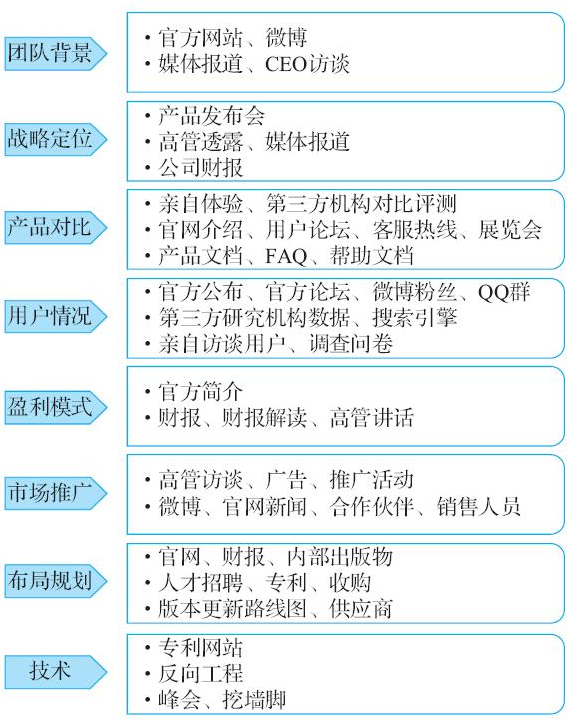
Common data sources: Baidu Index, Umeng, Alibaba Index, Tencent Big Data, Analysys, iResearch, CNNIC, TalkingData, Alexa, Qimai Data Patent search: Patent Search and Analysis
3.5 Organizing and Analyzing
Don’t just collect information — process it. Don’t just list findings — actually analyze them. Processing means summarizing, categorizing, combining, and checking reliability.
Common analysis methods:
3.5.1 Comparison Methods
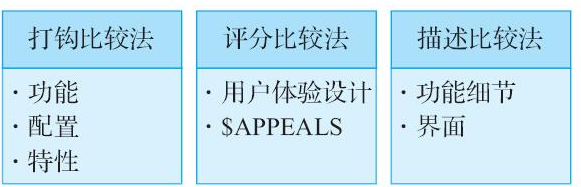
Checkbox comparison, scored comparison, descriptive comparison (see $APPEALS).
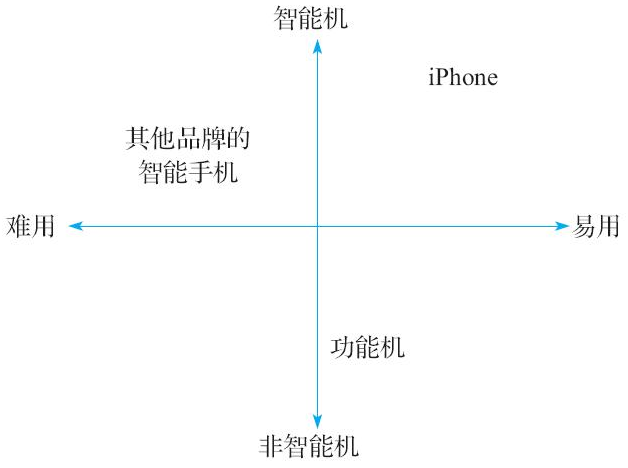
3.5.2 Matrix Analysis
Identify the key competitive factors and use them to think through positioning.
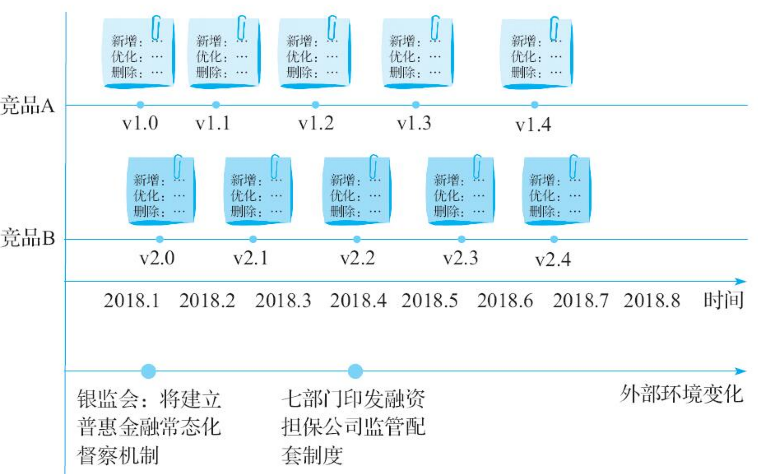
3.5.3 Competitor Tracking Matrix
Time-consuming, so it’s usually reserved for core products. For products that ship fast, frequent small updates, roll them up and analyze the major releases instead.
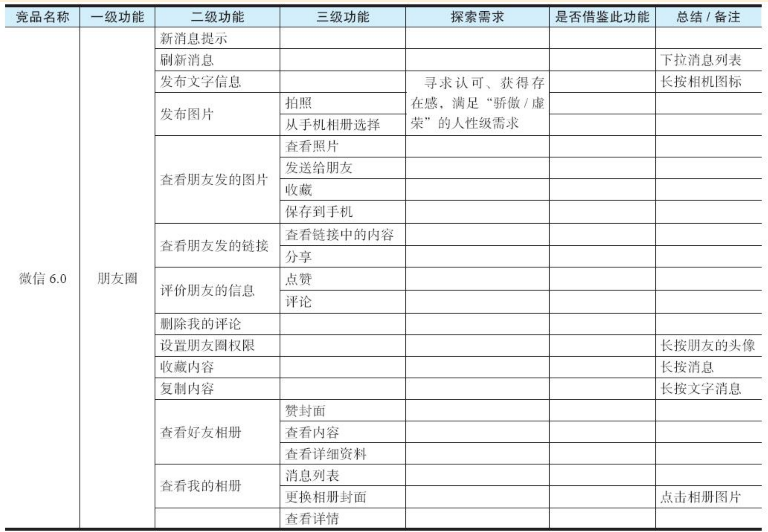
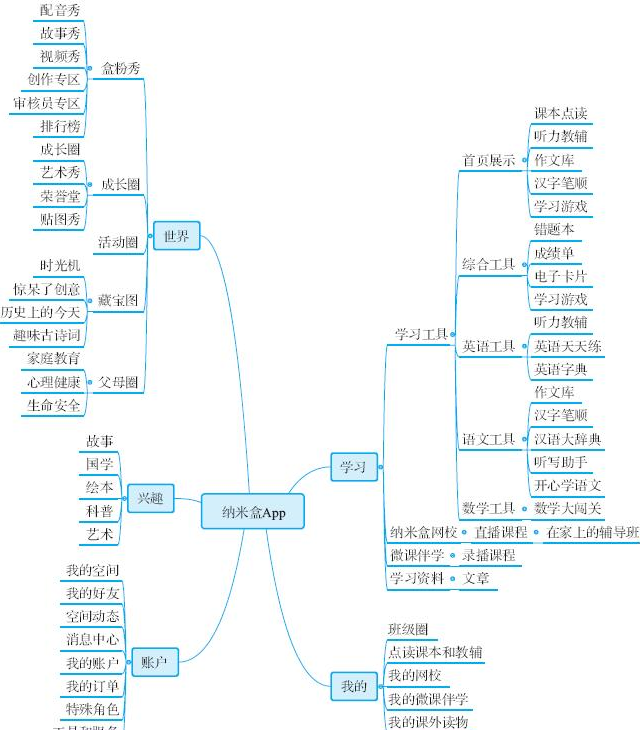
3.5.4 Feature Breakdown
Get a full picture of what a competitor’s product is made of so nothing slips through the cracks. Ways to do it: (1) break it down by nav menu, (2) by user flow, (3) by interaction pattern, (4) by reading the product manual.
3.5.5 Digging into the Real Need
Dig past the surface to find the deeper need a competitor’s product is actually satisfying — that’s where a better solution comes from. Needs sit at three levels: solution-level → problem-level → human-level. Say a user needs a chair — that’s a solution-level statement. Is a chair really what they need? It’s just one way to solve their actual problem. Maybe what they actually want is to rest — that’s the problem-level need. Push one layer deeper: why do they want to rest? In an extreme example, maybe they want to live longer so they have more time with family and more time to enjoy life — that’s the human-level need underneath it all. Once you’ve found that, you can build toward it directly. Forget the chair — build an “ion recovery chair” that claims to extend your life… if the user has a strong enough underlying need, they might drop the chair entirely and buy your product instead.
In practice, don’t stop after asking “why” once or twice — keep pushing until you hit the real reason. It’s basically Toyota’s 5 Whys.
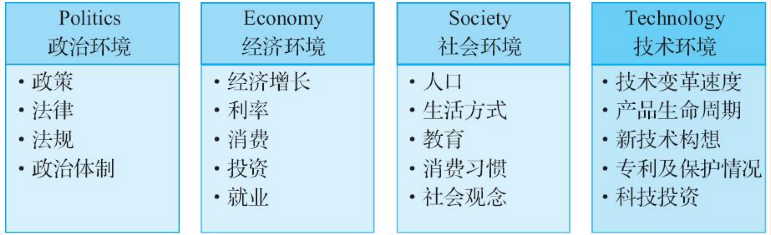
3.5.6 PEST Analysis
A product sits inside three nested layers: macro environment → industry environment → company environment → product. PEST analysis looks at the macro environment — building a product means working with the tide, not against it, and macro forces can make or break a product or even a company. Combine PEST with Porter’s Five Forces and you get the opportunities and threats half of a SWOT. PEST works well as a group brainstorm: have people from different roles list macro factors independently, merge the similar ones, then vote to pick the top 3–5.
Beyond the classic PEST factors there’s also law, demographics, ecology, and others — pull them in as needed. And since the outside world moves fast, PEST analysis needs to be refreshed regularly.
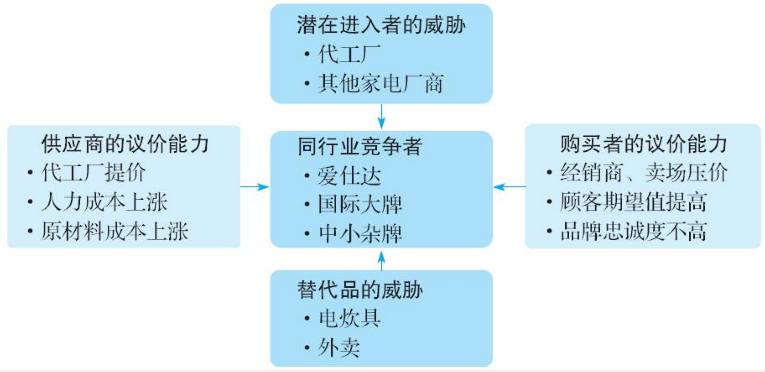
3.5.7 Porter’s Five Forces
Porter’s Five Forces looks at the industry environment — how attractive and profitable the industry is. How strong each of the five forces is determines how competitive the industry gets, which in turn determines how sustainable high margins are. Strong supplier bargaining power makes it hard to push costs down; strong buyer bargaining power makes it hard to push margins up.
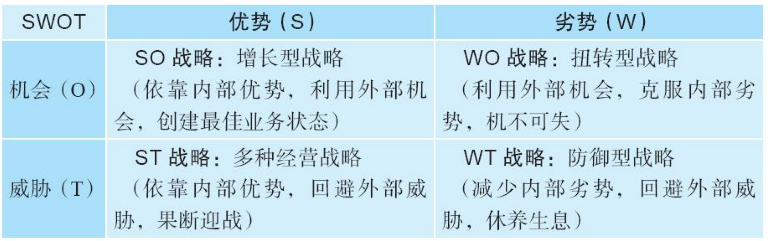
3.5.8 SWOT Analysis
Works like a checklist — laying out factors across all four quadrants to help shape a competitive strategy. Strengths and weaknesses are internal; opportunities and threats are external. Strengths and weaknesses should come out of actual comparison with competitors, not guesswork. And don’t just list everything — filter and distill to what’s actually relevant to your analysis goal and dimensions. Doing a proper SWOT usually pulls in several of the methods above — comparison, matrix analysis, PEST, Porter’s Five Forces.
3.6 Writing the Summary
The summary should be value-driven and built around the original goal of the analysis. It typically needs to land on a competitive strategy and action plan. A few frameworks help with that:
3.6.1 SWOT-Based Strategy
3.6.2 Porter’s Three Generic Strategies
- Cost leadership: cut production and operating costs to win on price and earn above-average industry margins. Works best for companies doing manufacturing at scale.
- Differentiation: build something different from competitors and win users on unique value. Tools for this include the strategy canvas and the eliminate-reduce-raise-create grid. Works best for companies with a broad product line.
- Focus: also called niche strategy — serve one specific user group or market segment well. Works best in a narrow market.
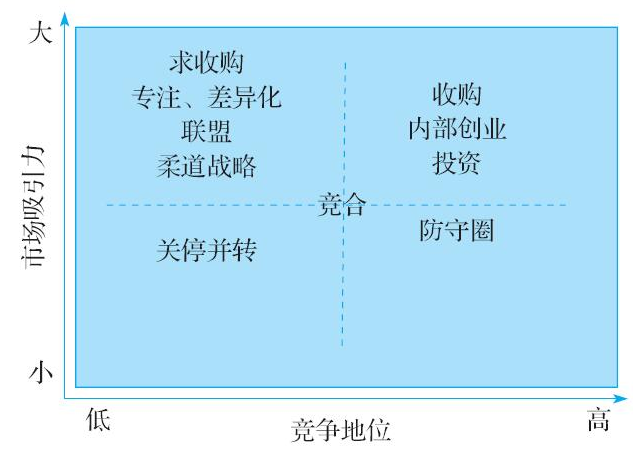
3.6.3 Other Competitive Strategies
4 Tools for Competitive Analysis
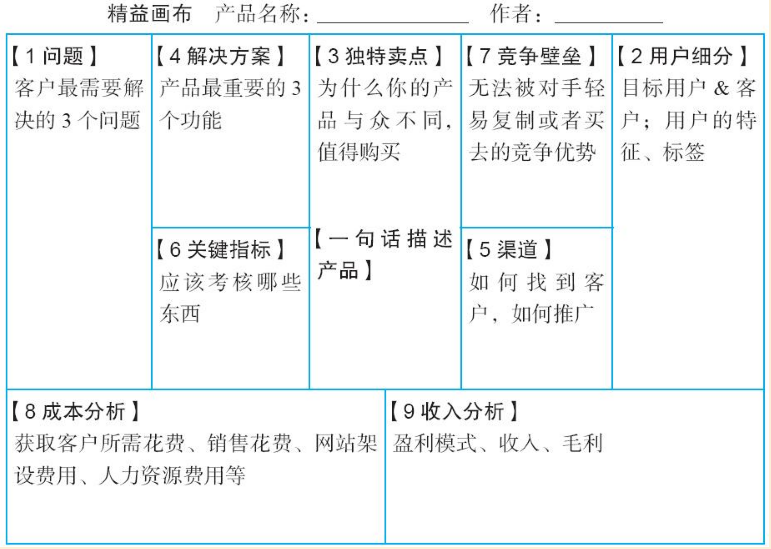
4.1 Lean Canvas
The lean canvas is for mapping out and analyzing a product’s business model. Ash Maurya introduced it in Running Lean — it helps a PM think more holistically, make better calls, and build a full-picture view of the product from a systems and business standpoint. Use it for product planning, breaking down a competitor’s business model, or as a discussion tool.
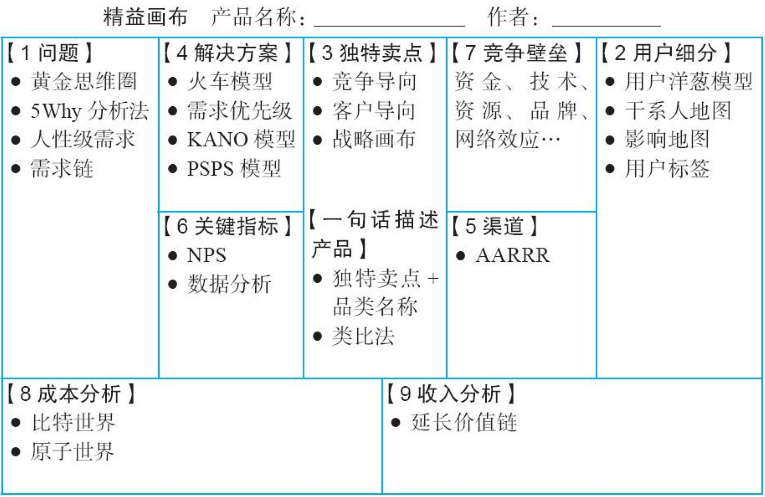
Lean canvas tools and methods:
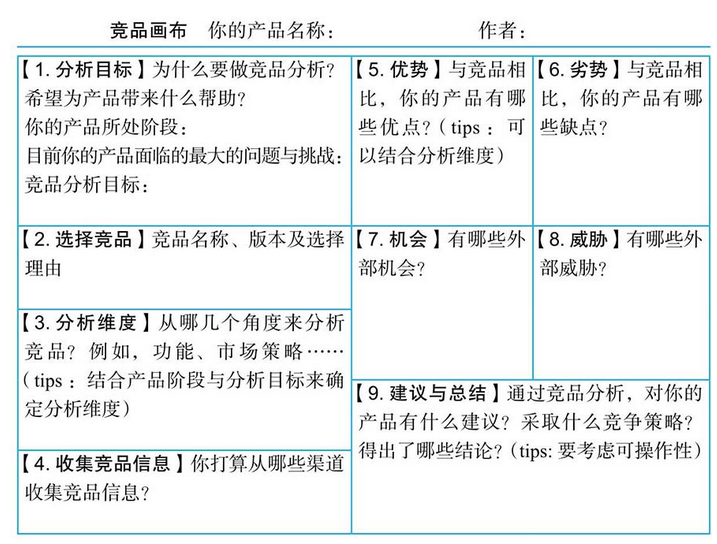
4.2 Competitor Canvas
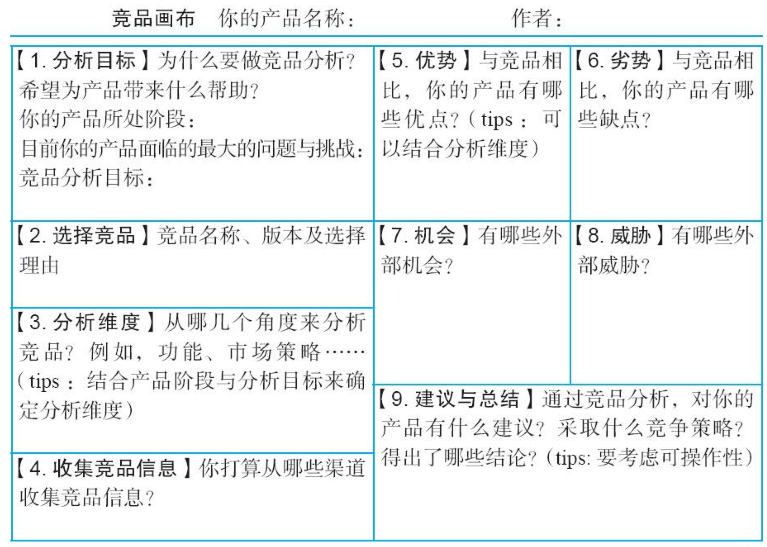
The competitor canvas is basically the MVP of a competitive analysis report. It’s a quick way to get started and validate your direction early, so you don’t end up writing a full report that misses the point.
4.3 Strategy Canvas
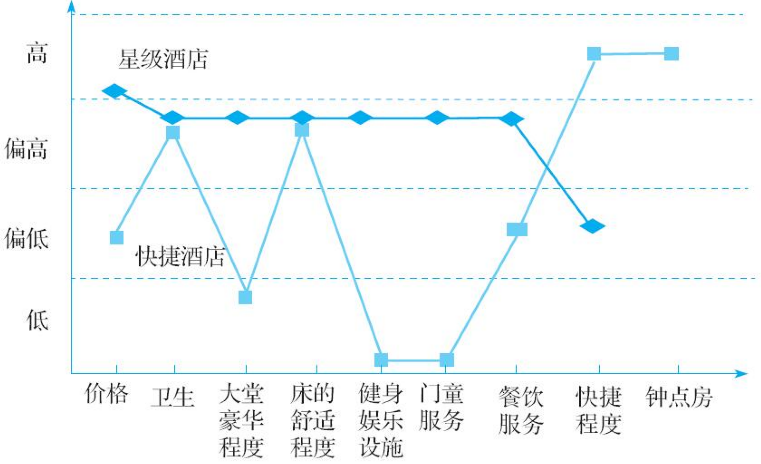
The strategy canvas helps you map out a “blue ocean” strategy — finding untapped markets through differentiation. In practice: plot a value curve with competitive factors on the x-axis.
Effective Competitive Analysis
Zhang Zaiwang