Notes from working through Cross-Border E-Commerce Payment and Settlement, my starting point for getting into cross-border payments.
A few basic concepts
Foreign exchange (FX)
Foreign exchange is a claim held by a country’s monetary authorities — the central bank, currency management bodies, exchange stabilization funds, and the treasury — in the form of bank deposits, treasury bills, and short- and long-term government securities, that can be drawn on to cover a balance-of-payments deficit. It covers foreign currency itself, foreign-currency deposits, foreign-currency securities (government bonds, treasury bills, corporate bonds, stocks), and foreign-currency payment instruments such as drafts, bank certificates of deposit, and postal savings certificates.
Broad definition
All of a country’s assets denominated in foreign currency — essentially the movement of money across borders and the conversion of one country’s currency into another’s to settle cross-border credit and debt. In practice this is the claim that a country’s monetary authorities (central bank, currency management bodies, exchange stabilization funds, and treasury) hold in the form of bank deposits, treasury bills, and government bonds, usable when the country runs a balance-of-payments deficit.
Narrow definition
Payment instruments denominated in a foreign currency, generally accepted internationally, and usable to settle cross-border debts. To qualify, an asset needs three properties: payability (it must be a foreign-currency-denominated asset), availability (the claim must be redeemable abroad), and convertibility (it must be freely exchangeable into other payment instruments).
Floating exchange rate regimes
The level of the franc’s exchange rate wasn’t set by speculators, by the trade balance, or even by adventures in the Ruhr — it was set by how much of their own income French taxpayers were willing to hand over to France’s rentiers. — Keynes
One basic anchor for an exchange rate is purchasing power parity. Say an egg costs RMB 1 in China and USD 0.2 in the US — then 1 RMB should trade for about 0.2 USD. If instead the two currencies traded 1:1, RMB 1 would still buy one egg at home, but converted to USD it would buy several eggs in America. People would rush to swap RMB for USD to buy American eggs, RMB would flow out to the US and eggs would flow into China. Domestic egg sellers would lose the market, domestic prices would stop being competitive, capital would keep leaving, and meanwhile demand for American eggs would outstrip supply, pushing US prices up until ordinary Americans couldn’t afford eggs — China would be buying up America’s eggs with cash it printed. Neither side wants that outcome, which is exactly why an exchange rate exists: to keep the domestic market stable and cross-border trade fair by converting between the two currencies.
Of course reality ran the other way round. We used to have gold as the yardstick; then the US came to dominate the world and the dollar replaced gold, with international settlement done in dollars — letting the US print money to buy eggs from the rest of the world. In 1973 the dollar-centered fixed exchange rate system finally broke down, and countries and regions moved one after another to floating rates. In practice, exchange rates are also shaped by trade protection, financial markets, and politics. To reduce our reliance on the dollar, we’ve been pushing RMB settlement, and we’ve also built a more stable exchange rate regime of our own.
China runs a managed float based on market supply and demand, referencing a basket of currencies — a managed floating exchange rate system. Each day the PBOC (People’s Bank of China) publishes the RMB’s rate against the dollar and other major currencies based on the prior day’s interbank FX market pricing, and banks quote their own rates within the band the PBOC sets around that midpoint. The PBOC itself is also a major player in the interbank FX market and can buy or sell FX to steer the rate as part of its monetary policy.
Traditional cross-border payment methods
Remittance
Remittance runs on commercial credit — the bank is just an agent carrying out an instruction; whether payment actually happens depends on the buyer honoring the contract.
- Mail transfer: the remitting bank sends a mail transfer order to the receiving bank, which then pays out to the beneficiary.
- Wire transfer (telegraphic transfer): the remitting bank sends an encrypted cable or telex to the receiving bank to release the funds.
- Remittance by draft: the payer actively pays the beneficiary using a draft, promissory note, check, or similar instrument.
Collection
Collection is the reverse of remittance — the documents move opposite to the funds. The exporter draws a bill of exchange on the importer and instructs its own bank to collect payment through the importer’s branch or correspondent bank.
Collection also runs on commercial credit: the bank acts strictly on the seller’s instructions, and whether payment is made depends entirely on the buyer’s creditworthiness.
- Clean collection: typically used for small amounts, advance payments, installments, or ancillary trade charges — the financial document isn’t accompanied by a commercial document.
- Documentary collection: the financial instrument travels together with the commercial documents.
Letter of Credit (L/C)
An L/C runs on bank credit. It’s independent of the underlying sales contract (a self-sufficient instrument) and detached from the goods themselves (a purely document-based transaction) — the issuing bank carries the primary obligation to pay.
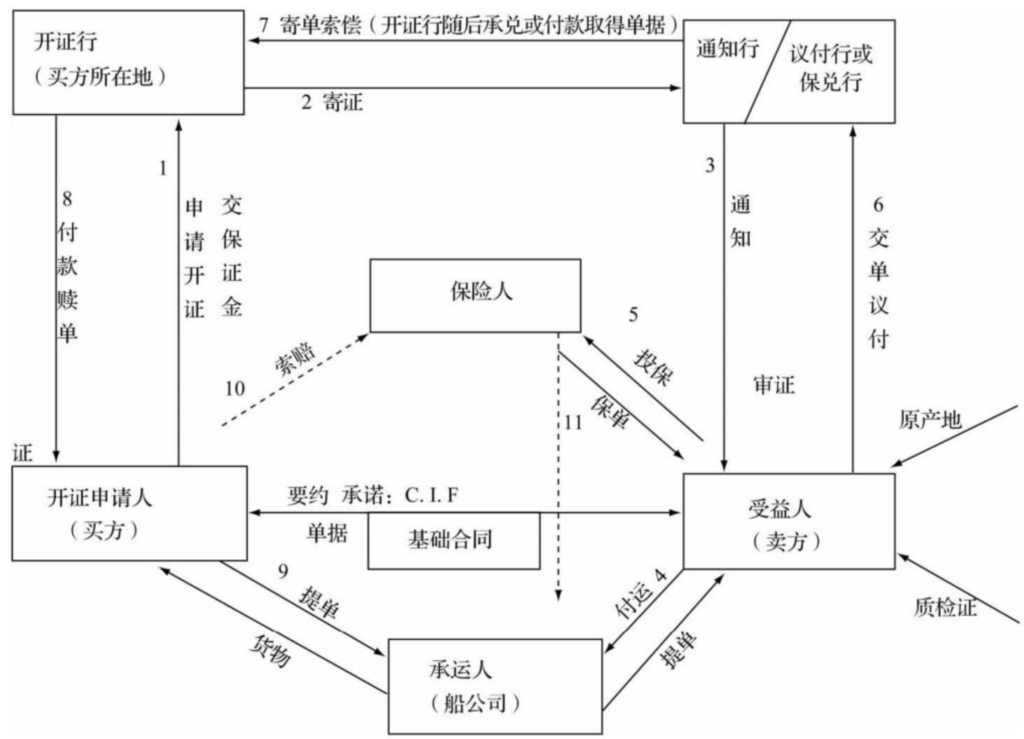
Newer cross-border payment methods
Traditional cross-border trade was mostly large-ticket B2B business settled through banks. As the internet took off, B2B, C2C cross-border e-commerce, and small-ticket B2B trade all grew fast, and a wave of new cross-border payment methods emerged alongside them. Domestically, most of these are run by third-party payment providers holding a payment business license from the PBOC and an approval from SAFE (China’s foreign exchange regulator) to run cross-border e-commerce FX payment pilots.
Some of the mainstream new-style cross-border payment options:
Domestic: Alipay, WeChat Pay, LianLian Pay, PingPong
International: PayPal, Western Union, WebMoney (widely used across Russian-speaking countries, Japan, Europe, and the US)
These providers mainly earn money from payment processing fees and payment solutions, plus some non-recurring income such as FX spreads.
Compared with traditional methods, the new-style cross-border payment options bring lower fees, simpler payment flows, faster settlement, and the ability to handle the high-concurrency traffic that platforms see.
How third-party providers implement payment
Cross-border e-commerce platforms typically integrate multiple payment channels and route between them — much the same as domestic payments.